
2026 BMW 3 Series vs. Audi A5: Why the 330i xDrive Wins the Sports Sedan Comparison
2026 BMW 3 Series vs. Audi A5: Why the 330i xDrive Wins the Sports Sedan Comparison
Posted on July 28, 2026
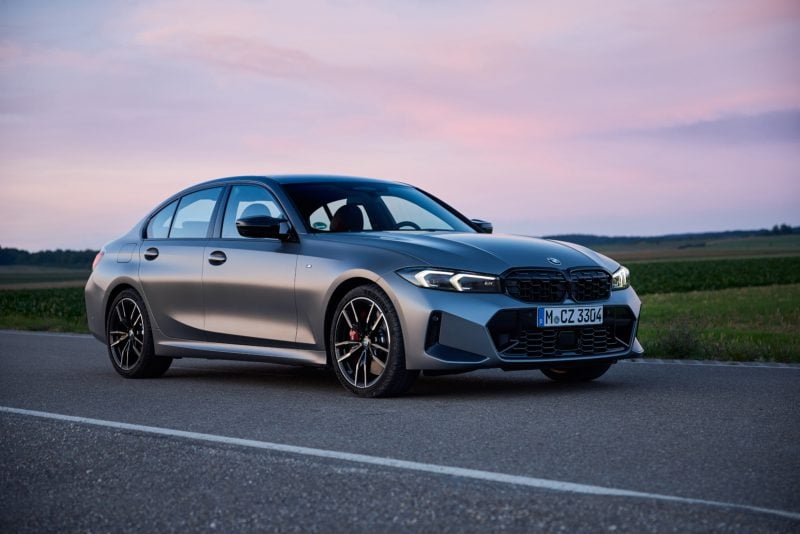 Shoppers cross-shopping the compact luxury sports sedan segment often land on two nameplates that have defined the category for decades: the BMW 3 Series and the Audi A5. Both cars come turbocharged, both send power to all four wheels, and both aim to satisfy drivers who want daily comfort during the week and sharper handling on the weekend. This guide lines up the 2026 BMW 330i xDrive against the 2026 Audi A5 quattro across engine output, chassis feel, and cabin technology. The two cars share a similar recipe on paper, a turbocharged four-cylinder engine paired with all-wheel drive, but how each one delivers that recipe on the road sets them apart.
At a Glance: 2026 BMW 330i xDrive vs. Audi A5
| Spec | BMW 330i xDrive | Audi A5 |
| 0–100 km/h | 5.6 seconds | 5.9 seconds |
| Curb weight | 1,702 kg | 1,855 kg |
| Wheelbase | 2,851 mm | 2,891 mm |
| Top speed | 210 km/h (250 km/h with performance tires) | 210 km/h |
| Torque | 295 lb-ft @ 1,600–4,500 rpm | 295 lb-ft @ 1,750–4,500 rpm |
| Horsepower | 255 hp @ 4,700–6,500 rpm | 268 hp @ 5,000–6,500 rpm |
| Drivetrain | xDrive all-wheel drive | quattro all-wheel drive |
| Transmission | 8-speed Steptronic automatic | 7-speed S tronic dual-clutch |
| Engine | 2.0 L turbocharged inline-4, 48V mild hybrid | 2.0 L TFSI turbocharged inline-4 |
Engine and Performance
The Audi A5’s 2.0-litre TFSI four-cylinder puts up a strong number on paper, 268 hp, and torque between the two cars is identical at 295 lb-ft. The BMW 330i xDrive answers with a 48V mild hybrid system that sharpens throttle response from a stop, and a curb weight that comes in 153 kg lighter than the A5. That weight advantage shows up directly at the stopwatch, where the 330i xDrive completes the 0-100 km/h sprint in 5.6 seconds, three-tenths quicker than the A5’s 5.9-second time. A few numbers worth knowing at a glance:
- 255 hp turbocharged inline-four with 48V mild hybrid assist for stronger low-end response
- 5.6-second 0–100 km/h time, quicker than the A5 despite giving up 13 hp on paper
- 1,702 kg curb weight, 153 kg lighter than the A5’s 1,855 kg
- 8-speed Steptronic automatic tuned for quick, direct gear changes
The 8-speed Steptronic automatic in the 330i xDrive also brings a different character to daily driving than the A5’s 7-speed dual-clutch. Torque-converter automatics like the Steptronic tend to deliver smoother, more predictable behaviour at low speeds and in stop-and-go traffic, a detail that matters more on a daily commute than a spec sheet lets on.
Handling and Chassis Feel
The 3 Series has carried a reputation for sporting balance since 1975, and the seventh-generation car sharpens that further with a stiffer mounting between the rear dampers and the body. The double-joint front strut axle and five-link rear axle, both built in lightweight aluminum-steel construction, work with the car’s lighter overall mass to keep the 330i xDrive composed through corners without giving up everyday ride comfort. Steering effort has also been tuned down in Comfort mode, so the car feels light and easy at low speeds and firms up when the driver wants more feedback. The A5 uses a comparable five-link independent front suspension and electromechanical progressive steering with speed-sensitive assist, a competent setup on its own. Against the 330i xDrive’s lighter frame and decades of chassis tuning refinement specific to the 3 Series nameplate, the BMW holds an edge in outright agility and driver feedback.
Interior Technology and Comfort
Inside, the 330i xDrive runs BMW Operating System 8.5 through the BMW Curved Display, with iDrive and QuickSelect bringing a flatter, faster menu structure and a customizable widget bar. The optional Digital Cockpit Professional adds a head-up display along with Augmented View, which overlays live directional guidance onto the driver’s forward view at complex intersections. The BMW Intelligent Personal Assistant also handles natural-language requests, from climate adjustments to route changes, without the driver needing to dig through menus. The A5’s cabin gains a redesigned infotainment interface for 2026, with fewer lists and more graphical layouts across its three digital displays, along with a new multifunction steering wheel that brings back a physical scroll wheel. Voice control expands as well, letting the driver operate select functions by speaking naturally. A quick side-by-side of the cabin tech that stands out on each car:
- BMW Curved Display with iDrive 8.5, QuickSelect, and a customizable widget bar
- Augmented View navigation overlay available with the Digital Cockpit Professional
- BMW Intelligent Personal Assistant for natural-language voice commands
- Audi’s redesigned MMI interface with graphical layouts and expanded voice control
Which Sports Sedan Fits Your Drive?
Drivers cross-shopping this segment are usually looking for the same thing: a car that feels alive on a curving back road and settles down comfortably during the week. The 330i xDrive’s lighter chassis, quicker acceleration, and steering tuned around five decades of 3 Series development give it a clear advantage for that kind of driving. Add in a torque-converter automatic built for smooth low-speed behaviour and a cabin that pairs the BMW Curved Display with Augmented View navigation, and the 330i xDrive rounds out its case as the more complete package for a driver who spends real time behind the wheel rather than just admiring a spec sheet.
Experience the 330i xDrive at BMW Laval
Numbers on a page only tell part of the story. Book a test drive at BMW Laval to feel the difference the 330i xDrive’s lighter chassis and quicker acceleration make behind the wheel, and let our product specialists walk through the full spec sheet in person.